Wayside Fiber, Part 3: Who Keeps It True
The institutional plant: why the grant that built the corridor funds nothing that keeps its records accurate, how an OTDR baseline doubles as a defensible condition assessment, and why change control is the only difference between a record and a rumor.
Part 3 of Wayside Fiber. Part 1 built the physical plant, Part 2 the logical one. This part is the layer that actually degrades.
The thirty-year cable and the eighteen-month drawing
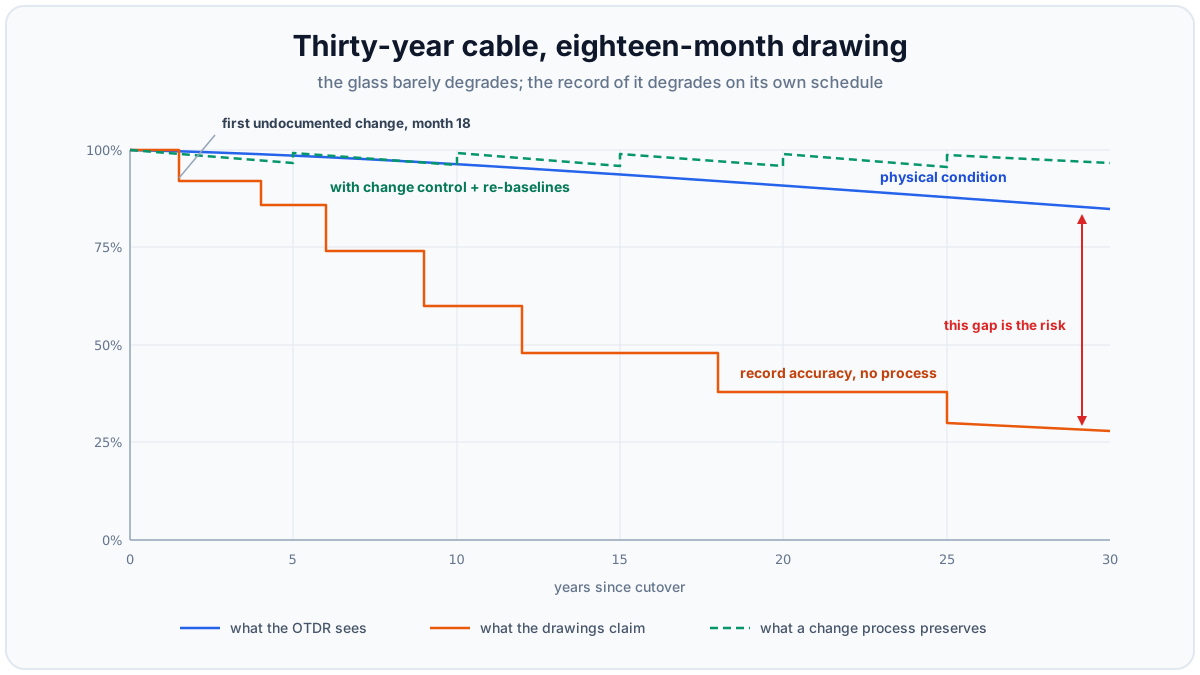
State the thesis cold: the glass in our corridor will still meet specification in thirty years. The as-built drawings describing it were last fully accurate about eighteen months after cutover, and nothing in the project that built either one is funded to close that gap.
The physical plant and the record of it degrade on different schedules. Only one of them degrades by default.
Every step down on the orange line is an event from this series. The midspan access added a splice location no original drawing shows. The duplicate-address incident happened because a record went unconsulted, and its cleanup, undocumented, is another step down. None are failures of diligence; each was a competent crew solving the problem in front of them. The record decays through ordinary work done well by people with no mandate to write it down. The cable stays true on its own. The record needs help, and help has a payroll cost.
Capital builds, operating sustains
The corridor was built under a federal discretionary grant, like a great deal of wayside fiber. The grant paid for design, duct, cable, splicing, testing, even the as-builts as a deliverable. Then it ended, because that is what capital does: it buys things, and it is structurally incapable of buying truth over time: not the year-five OTDR re-shoot, not the hour a splicer spends updating the strand table, not the person who says no to an undocumented change.
All of that lands on the operating budget, the most contested money on any railroad, where "maintain the fiber records" competes with visible, urgent work and loses quietly every year, until the night it becomes the reason a four-hour restoration took sixteen. The institutional problem is exactly this: the asset is capital, its truthfulness is operating, and no one is born owning the second thing. Part of the fix is naming an owner. Part is giving that owner something defensible to point at, which is where an unlikely hero enters: the test set from Part 1.
The OTDR baseline is the condition assessment
Railroads and transit agencies increasingly live under formal asset management regimes; transit's TAM rule (49 CFR Part 625) with its state-of-good-repair reporting is the sharpest version. They all want the same thing: an inventory, a condition rating per asset, and a defensible basis for replacement timing.
Linear buried assets fit this machinery terribly. A vehicle can be inspected and rated by wear; a buried cable presents nothing to inspect, just a 30-year book life that is a guess dressed as a number. So buried plant gets rated by age alone, which fails expensively in both directions: healthy 25-year-old cable scheduled for replacement it does not need, and a corridor rated "good" by birthday while water eats a splice case.
Now reframe what Part 1 built. At acceptance, every strand was shot bidirectionally at two wavelengths and every event got a measured loss. That is not just a commissioning artifact. It is a quantitative, per-event, spatially resolved condition baseline for the whole asset. Re-shoot the same strands in year five and the comparison is a condition assessment of a rigor almost no other asset class can offer:
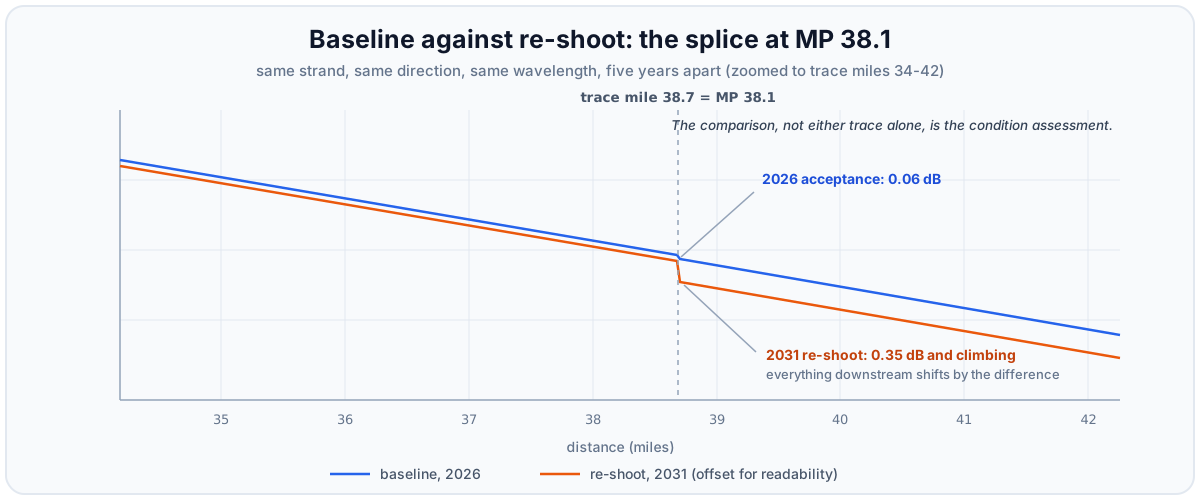 Baseline against re-shoot. The splice at MP 38.1 has moved from 0.06 to 0.35 dB: water is in the enclosure, found from a test set, years before it becomes an outage.
A splice that was 0.06 dB and is now 0.35 is water intrusion announcing itself years early. A section whose slope grew at 1550 nm but not 1310 is ground movement stressing the cable. Unchanged traces are equally valuable: they are evidence, not assumption, that the 25-year-old corridor is in a state of good repair and needs no capital. Either way, the answer to "what is the condition of this asset and how do you know" becomes a measurement with a date on it.
The budget reframe follows. A periodic OTDR campaign proposed as testing is a maintenance expense, first thing cut. The same campaign proposed as the condition assessment program for an eight-figure linear asset, feeding the SOGR reporting the agency is federally required to produce, is asset management, defensible in exactly the venue where operating money gets decided. Same trucks, same test sets, different sentence, different outcome.
What sustainment actually costs
A list readers can lift into a budget request. This is what "keeping the corridor true" means as line items:
- Test equipment, owned and calibrated. An OTDR, a light source and power meter pair, an inspection scope, with calibration as a recurring line. Borrowed test sets produce baselines in formats you cannot compare.
- Splice capability, in-house or on retainer: a fusion splicer, closures, trays, and at least two people per territory who can use them at 2 a.m.
- Spares by lead time, not by consumption. You will almost never use the emergency reel of 48-strand cable, matching closures, and FDP pigtails. You stock them because the failure that needs them will not wait a procurement cycle, and the OSP market's lead times are measured in months.
- A pre-executed emergency restoration agreement with a fiber contractor: rates, response times, and mobilization terms signed before the dig-in, so the night of the failure is spent splicing instead of negotiating.
- The OTDR cycle: the re-baseline campaign on a fixed period (five years is a common rhythm), funded as the condition program described above.
- Record maintenance as named labor. Some fraction of a real position, written into a job description, for keeping drawings, strand tables, and IPAM current. Unowned work is optional work; optional work does not survive contact with an operating budget.
- Training, including the unglamorous kind: the next generation of splicers, and cross-training so the addressing record from Part 2 is not one retirement away from folklore.
None of these items is large. All of them are the first things cut when they are framed as overhead, which is why the framing in the previous section matters.
Two more line items hide in other budgets. Power: the switches ride the signal battery plant, so a fiber ring is exactly as redundant as the batteries under its ends; battery maintenance is network sustainment wearing a different account code. And degraded-state alarming: a healed ring is a corridor with no spare fault, and ERPS reports that state; if it does not page anyone, the redundancy has quietly become the primary, and nobody learns that until the second cut.
The documentation set
"Keep good records" is advice nobody can execute. A named set of artifacts, each with an owner and an update trigger, is a system. The corridor's set:
| Artifact | Contents | Owner | Updated when |
|---|---|---|---|
| Record drawings | Route, depths, vaults, laterals, houses | Engineering | Any plant change |
| Strand ledger and splice records | The corridor ledger, splice sheets, port maps, and jumper schedules from Part 1 | Signal/comms engineering | Any splice, assignment, or jumper change |
| OTDR baselines | Acceptance and periodic traces, both wavelengths, both directions | Comms maintenance | Acceptance, re-shoot cycle, any repair |
| IPAM / address record | Every address, VLAN, and port assignment | The seam from Part 2: jointly, in writing | Any assignment, before it is made |
| Config backups | Switch, gateway, and vital comms configurations | Comms maintenance | Any config change, automatically |
| FRA test records | Required periodic tests on the signal side, per 49 CFR 236 | Signal maintenance | On the regulatory cycle |
Two things about this table. First, the gaps announce themselves: if you cannot fill in the "owner" column for one of these on your own railroad, that row is currently a rumor, and now you know which one. Second, notice the artifact that spans departments: the address record from Part 2's seam appears here with a joint owner, in writing, because a record with two informal owners is a record with none.
If the set feels like overhead, price it against the night it gets used. A backhoe finds the cable at 2 a.m. somewhere near MP 31. Walk the restoration twice, once with current records and once without:
| Restoration step | Records current | Records stale |
|---|---|---|
| Locate the fault | OTDR distance mapped to a known route: under an hour | OTDR gives a distance along a route nobody trusts: hours of driving and digging |
| Identify what is down | Strand table read off in the office | Toning, tracing, and phone calls to whoever might remember |
| Restore in the right order | Vital pairs spliced first, corridor signaling back early | Splice all 48 and hope, vital back whenever it is back |
| Confirm restoration | Compare against baseline traces | Argue about whether 0.4 dB "was always like that" |
The plant damage is identical in both columns. The outage duration is not, and the difference is purchased entirely in advance, in the unglamorous currency of the table above.
Change control, or: the only mechanism
Everything above fails without one final piece, because every artifact in that table shares one failure mode: change without record. The midspan access, the address cleanup, the swapped optic: each was a competent change that made a record false somewhere else.
The fix is boring: a documented engineering change process, sized to the railroad. No board, no software, three properties: every change is proposed somewhere visible before it happens, recorded in the artifacts it touches when it happens, and checked by someone other than its maker. Under even the lightest version, the bench tech staging Chester's recorder looks up the address first and Part 2's incident never happens; the crew at MP 38.1 leaves drawings that still tell the truth.
Change control has a reputation as bureaucracy, and badly sized versions earn it. Stripped to its function, it is the principle this series started with, applied to information: a change process is how a record fails safe. When it is missing, the change stops and asks, instead of silently making the map wrong.
Close: what actually degrades
Run the series backward. The physical plant is a solved problem: glass, duct, and budgets are engineering, and Part 1's corridor will pass every test for decades. The logical plant is solvable: schemas, VLANs, and timers are decisions, and Part 2's corridor makes them correctly. Neither is what fails.
What degrades is institutional memory: the accurate drawing, the current spreadsheet, the person who knows why tube 4 was never opened, the budget line with an advocate. That layer has no gravity-dropped relay; it does not fail toward safety, it fades, and every failure that follows lands harder for it. The corridor's real thirty-year project is not keeping the light on. It is keeping the description true enough that the night the light goes out, the people holding the record can trust it.
Back to the series introduction, or start again at Part 1: Where It Is.