Wayside Fiber: Three Layers, Three Failure Modes
A three-part series on the fiber plant beneath modern railroad signaling: where the cable physically runs, how the network on it talks, and who keeps the record true. One corridor, carried through all three parts.
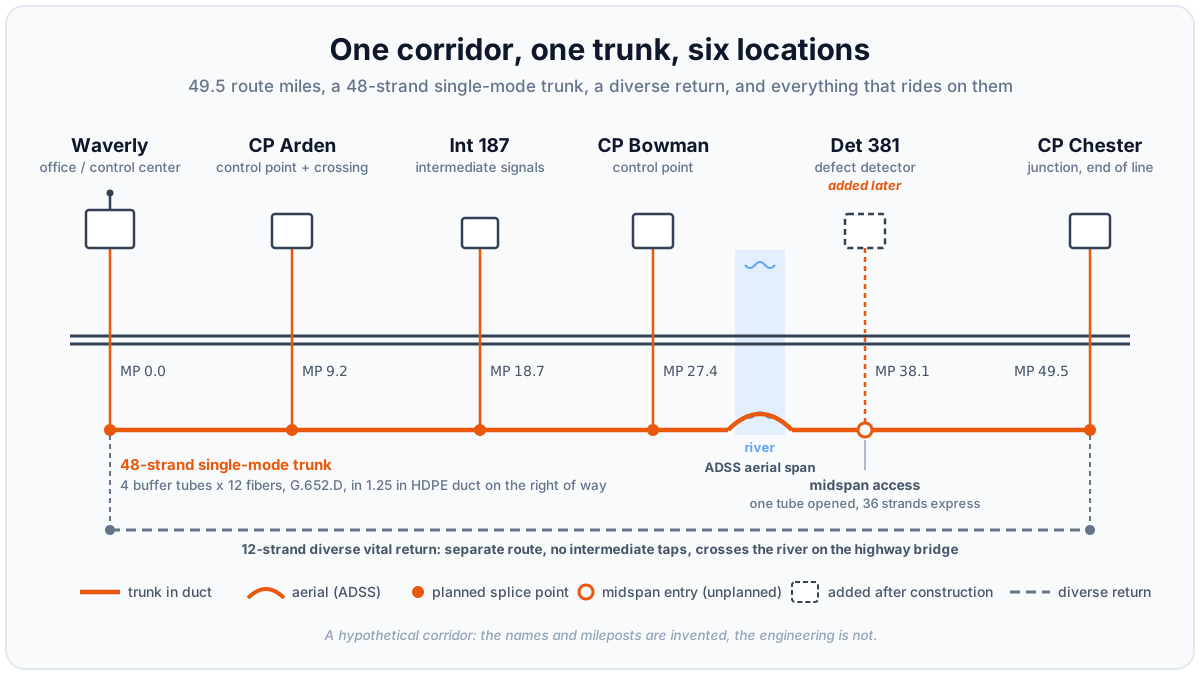
Ask a signal engineer what the railroad runs on and you will hear about track circuits, interlockings, and vital processors. All true. But follow the equipment in any modern wayside house back far enough and everything lands in the same place: a yellow jumper, a distribution panel, and a buried cable full of glass. Vital comms, crossing monitors, defect detectors, event recorders, cameras, the maintainer's phone: one cable. The wayside fiber network is not a utility bolted onto the signal system. It is the substrate the signal system rides on.
That substrate fails three different ways, and they have almost nothing in common.
It can fail physically: a backhoe, water in a splice case, a loss budget that never closed. Loud failures. You know in seconds, and the fix is a crew, a splice trailer, and a long night.
It can fail logically: perfect glass, useless network. A spanning tree that reconverges slower than a vital processor's patience, a duplicate address surfacing two years after somebody cloned a config. Confusing failures: they look like hardware, they get chased like hardware, and they never are.
And it can fail institutionally. Nothing breaks. The cable outlives the person who documented it, the as-builts drift, the strand table lives on one laptop, and a routine repair takes four times longer than it should because nobody living knows which tube feeds what. Silent failures, and the ones that turn the other two kinds from incidents into ordeals.
Three layers, three failure modes, three disciplines. That is the series.
The corridor
Everything happens on one railroad: 49.5 miles, six locations, from the office at Waverly to the junction at CP Chester, tied together by a 48-strand single-mode trunk plus a small second cable on a separate route, because a safety-critical ring is only a ring if one dig-in cannot take both directions of it.
One corridor, six locations, 49.5 miles. Every diagram in the series comes back to it.
The three parts
Part 1: Where It Is is the physical plant: why signaling went to glass, what is inside the cable, how a midspan access works, and how a loss budget fails at the far end. It ends with a link LED lit at every location and nothing able to reach anything.
Part 2: How It Talks is the logical plant: which devices may share a wire with vital equipment, an addressing schema that encodes the corridor into four octets, and ring reconvergence racing a vital processor's stale-data timer. It also pays off a disaster this sentence is quietly planting: a replacement recorder will arrive owning another location's address.
Part 3: Who Keeps It True is the institutional plant: why the grant that built the corridor funds nothing that keeps its records accurate, how an OTDR baseline doubles as the condition assessment asset management keeps asking for, and why change control is the only difference between a record and a rumor.
The cable will last thirty years. Read in order.